
The folllowing poems were re-assembled from letters sent home by Carol Milton Merchant, grandfather of Megan Merchant, who fought in WWII from March 31, 1944 to November 3, 1945.
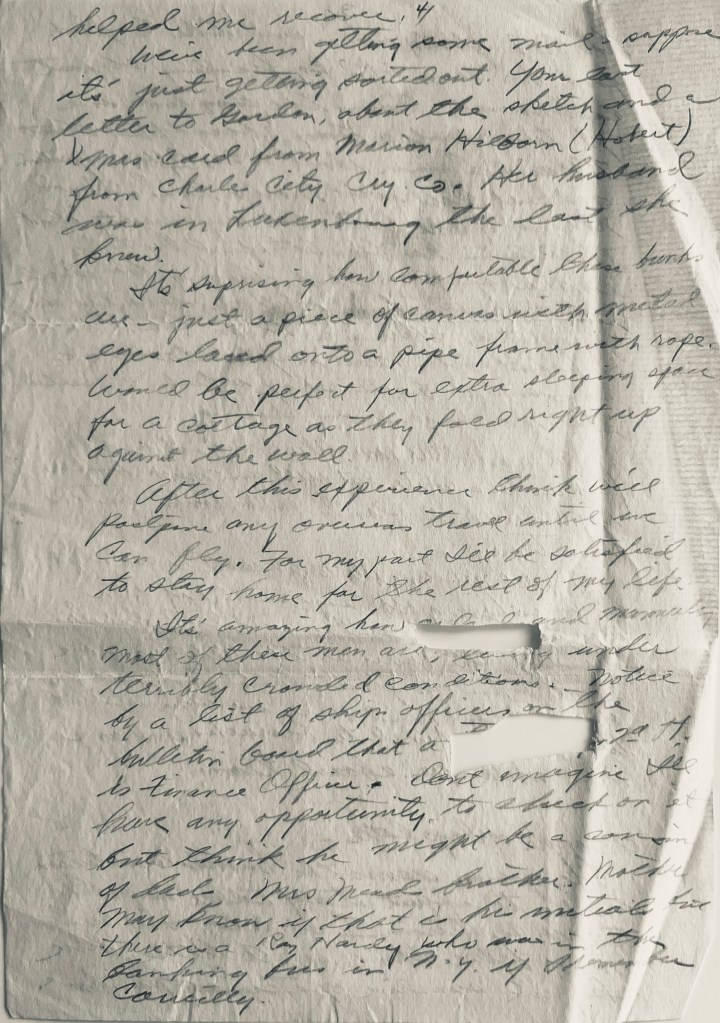
Disembarked at Firth of Forth about twilight.
We slept on triple decked canvas bunks
that were set up everywhere—
even in halls and in swimming pools.
I talked to a sailor on deck
that morning and he said
in peacetime we wouldn’t
be making the trip in such weather—
one of the worst Atlantic storms
in a decade, waves 80 feet high.
Because of her speed we are travelling
the sea lane alone but stalked
by German U-Boats.
After this, I think we’ll postpone any overseas
travel until we can fly. For my part, I’ll be satisfied to stay
home for the rest of my life.
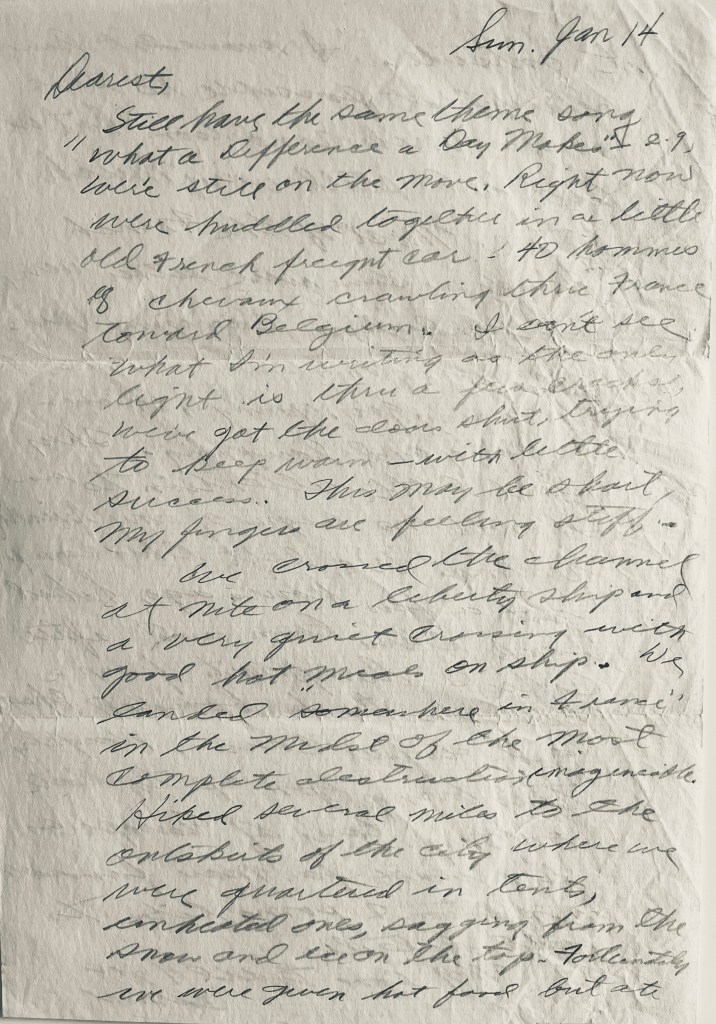
The very next day we were herded into freight cars
We are still on the move, right now—huddled
together in a little old French freight—
40 Hommes et Chevaux—
crawling through France towards Belgium.
I can’t see what I’m writing
as the only light is through a few cracks—
we’ve got the doors shut,
trying to keep warm.
We landed somewhere in France
in the midst of the most complete
devastation imaginable
and hiked several miles to the outskirts
of the city where we quartered
in confiscated tents, sagging from snow
and ice. I wouldn’t have believed
it possible to live under such conditions,
but we did and are still very much alive.

I was told to find a place to sleep in the building over the mess hall.
Bed rolls covered the floors, except one corner where the wall
had been blown out. I got a dresser drawer to cover the hole and
unrolled my infantry sack. It was already dark. I got to see my first V-
bomb streak across the sky—an eerie sight, a man-made shooting
star. A battery of big guns fired incessantly through the night.
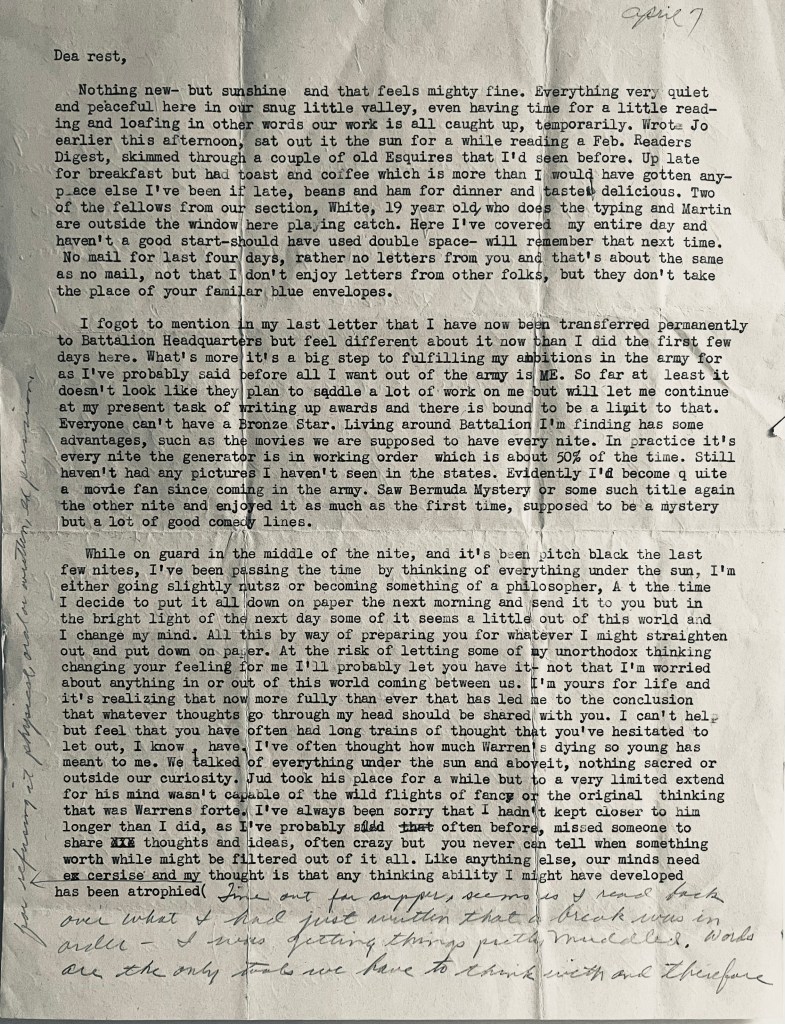
While on guard in the middle of the nite,
and it’s been pitch black the last few, I’ve been passing the time
by thinking of everything under the sun. I’m either going slightly
nutz or becoming something of a philosopher. At the time I decide
to put it all down on paper the next morning and send it to you,
but in the bright light of the next day some of it seems a little
out of this world and I change my mind.
All this by way of preparing you for whatever I might straighten
out and put down on paper. At the risk of letting some of my unorthodox
thinking change your feelings for me, I’ll probably let you have it—
not that I’m worried about anything in or out of this world
coming between us. I’m yours for life.
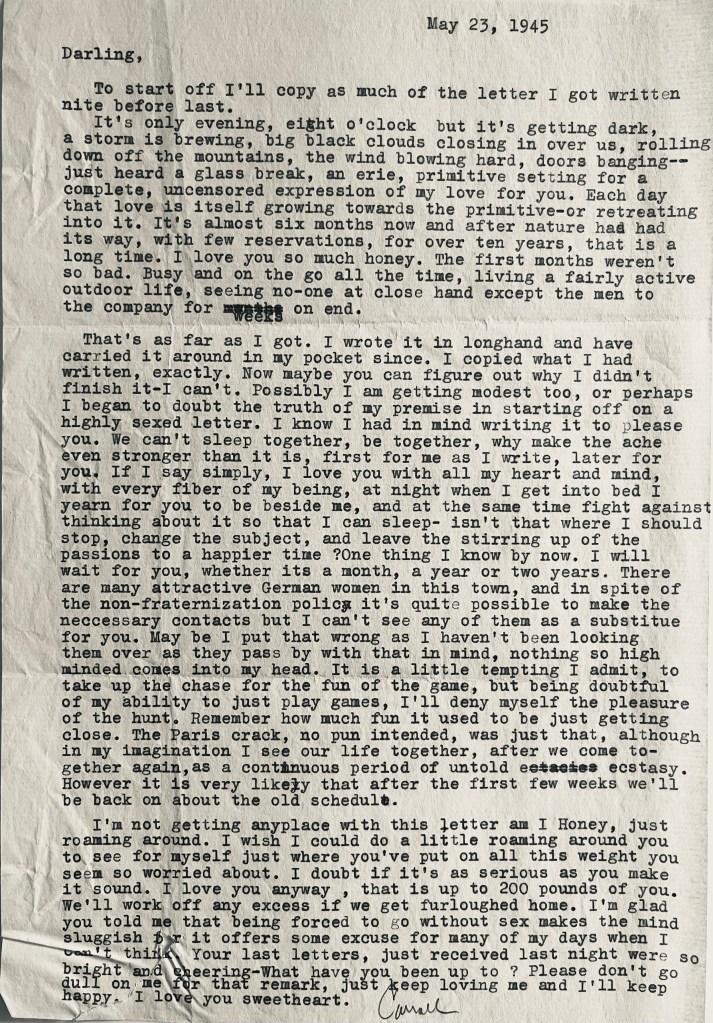
I’m glad you told me that being forced to go without sex makes the mind sluggish for it offers some excuse for many of my days when I don’t think.
It’s only evening, eight o’clock,
but it’s getting dark,
a storm is brewing,
big black clouds
closing in over us,
rolling down
off the mountains,
the wind blowing
hard, doors banging—
just heard a glass break,
an eerie, primitive
setting for a complete
uncensored expression
of my love for you.
Each day that itself
is growing towards
the primitive—or retreating
into it—
That’s as far as I got.
I wrote it longhand and have carried it around in my pocket since.
I know I had in mind writing it to please you.
Megan Merchant (she/her) is the owner of the editing, manuscript consultation, and mentoring business Shiversong and holds an MFA in International Creative Writing from UNLV. She is a visual artist and the author of three full-length poetry collections with Glass Lyre Press: Gravel Ghosts (2016), The Dark’s Humming (2015 Lyrebird Award), Grief Flowers (2018), four chapbooks, and a children’s book, These Words I Shaped for You (Penguin Random House). Her book, Before the Fevered Snow, was released in April 2020 with Stillhouse Press (NYT New & Noteworthy). Most recently, she was the recipient of the New American Poetry Prize 2024 for Hortensia in Winter.
Carol Milton Merchant served in the army during WWII as an Infantryman, a Truck Driver with the 774th “Blackcats” (Involved in all major European Battles, including the Battle of the Bulge, the crossing of the Roer, etc.). He later served as a General Clerk who handled awards and decorations, a Public Relations Liaison, and finally, he supervised the setup of (and teaching in) a Battalion school for the Army of Occupation.
 ISSUED